Local IVR
Overview
A "Local IVR" is a full-fledged Interactive Voice Response (IVR) system that runs locally within a campaign's context. While a standard IVR typically handles incoming customer calls before they reach an agent, a Local IVR is often used during an active call.
Agents can conference a customer into a Local IVR to automate specific processes, capture sensitive data, or collect post-call feedback without disconnecting the line.
Interactive Voice Response (IVR) is an automated system that allows customers to interact with a contact center using their telephone keypad (DTMF tones).
Note: Local IVR is a licensable feature. Ensure you have procured the appropriate license to view and use this tab in your campaign settings.
Business Use Cases
- Secure Data Collection (Automated Payments): An agent conferences a customer into a secure Local IVR to enter credit card details or PINs. The information entered via DTMF tones is processed by the system and is not visible to the agent, ensuring PCI compliance and security.
- Customer Verification: Agents can route a caller to an IVR to verify their account number or identity before proceeding with a sensitive transaction.
- Self-Service: Providing customers with options to check account balances or track an order automatically.
How It Works
A call is directed to a pre-configured call flow (nodeflow). The IVR plays audio prompts (e.g., "Press 1 for Sales"), and the customer's key press determines the next step, such as transferring to a queue or another IVR menu. Agents can also conference a customer into a Local IVR for assisted processes.
Prerequisites
- Licensing: This is a Licensed Feature and requires the appropriate license component to be procured and visible in the campaign settings.
- Campaign Assignment: Must be configured within the Interactive Voice Application Campaign Settings (Inbound Campaign).
- Call Context: The Local IVR must be associated with a Call Context that has been assigned to the campaign.
- Nodeflow: A nodeflow must be designed by Professional Services team as per the business requirement.
Configuration Steps
Administrator/Voice-Admin Configuration
"Local IVR" Tab in Interactive Voice Application Campaign Settings lets the Administrator create the Local IVRs.
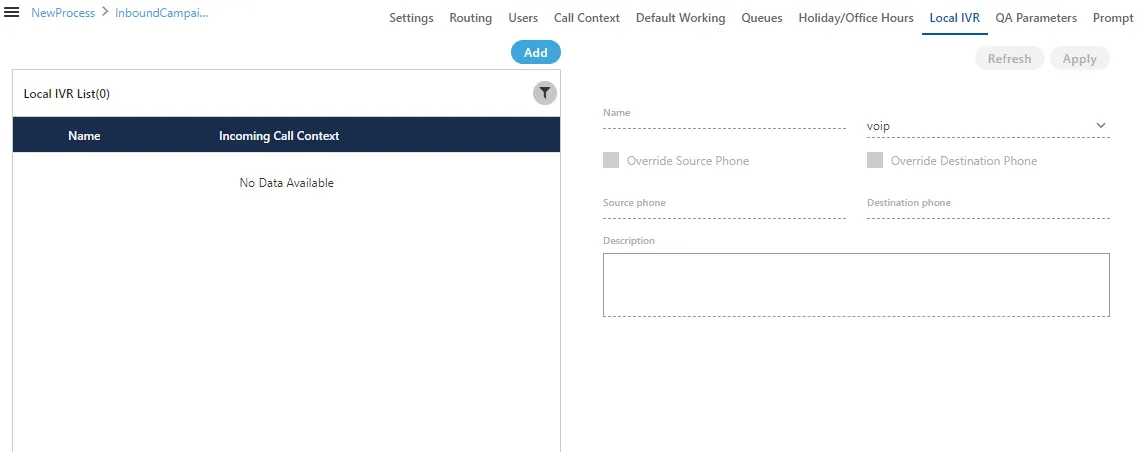
Add a Local IVR
Perform the following steps to add a Local IVR.
- Click "Add" to add a Local IVR using the following pop-up.
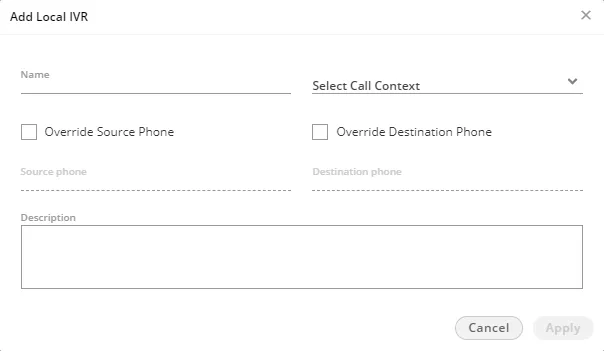
- Provide a name for the new IVR.
- "Call Context" drop-down menu lists all Call Contexts that you have assigned to this campaign. Select anyone of them.
- Select "Override Source Phone" option to override the source number (from which a call is being received) of the incoming call with the provided number. After checking it, provide a number in its relevant textbox.
- Select "Override Destination Phone" option to override the destination number (to which a call is being dialled) of the outbound call with the provided number. After checking it, provide a number in its relevant textbox.
- Provide a description in "Description" text box.
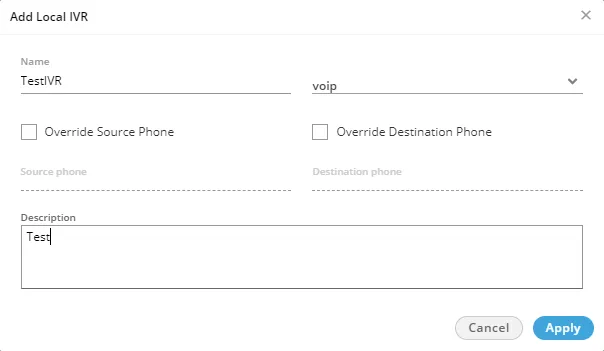
- Click "Apply" to create the local IVR using the selected call context. Rather you can click "Cancel" to not create it
You can follow these steps to create multiple Local IVRs.
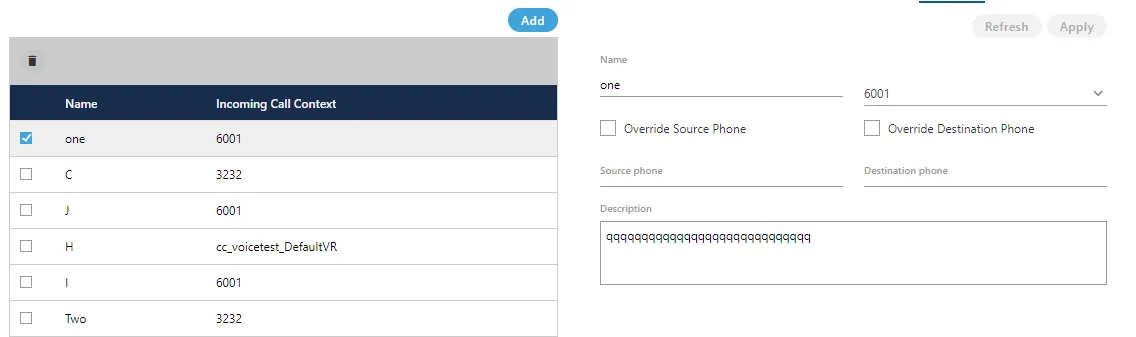
Modifying an IVR
Perform the following steps to modify an existing Local IVR in the Campaign Settings.
- In "Local IVR" tab, select a Local IVR to view its details in the right panel.
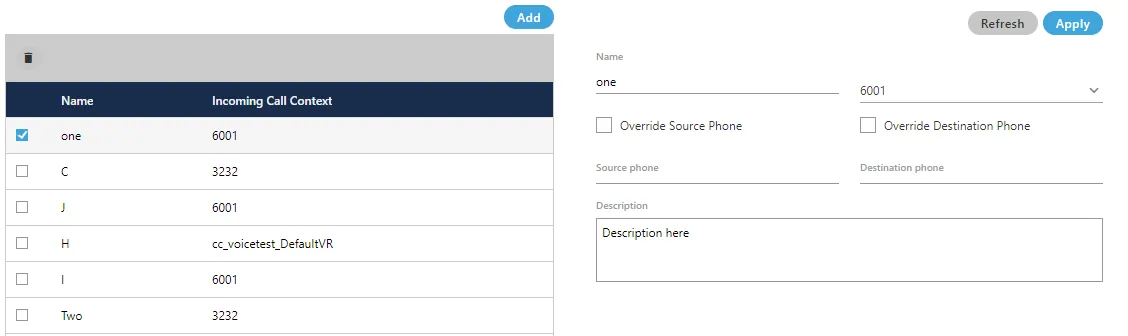
You can change the following fields while modifying a local IVR.
- Name
- Call Context
- Enable or disable the option to override the Source Phone
- Already provided Source Phone Number
- Enable or disable the option to override the Destination Phone
- Already provided Destination Phone Number
- Description
- If the System-level Call Routing Plan is created based upon the Call Context, Source Phone Number, or Destination Phone Number, then Call Routing will not work for this IVR if you change any of these fields.
- If the Campaign-level Call Routing Feature is created based upon the Call Context, then the Call Routing will not work for this IVR if you change the Call Context.
- Validate the changes carefully as the Call Routing can be disabled for this Local IVR if any change is made to Call Context, Source Phone, or Destination Phone.
- Click "Apply" to apply the changes.Rather, you can click "Cancel" to discard the changes.
Delete an existing Local IVR
- The Deleted Local IVR will not be played at the assigned Call Context Feature, Source Phone Number, or Destination Phone Number.
- The Deleted Local IVR cannot be restored using any method.
Sometimes an existing Local IVR becomes obsolete and it has to be replaced with an all new IVR. If you are planning to delete an IVR, then you have to plan properly before going ahead as the deleted IVR will not be played in the Call Flow.
Perform the following steps to delete a Local IVR.
- In "Local IVR" tab, select a Local IVR to view its details in the right panel.
- Click "Delete" button in the top right section. It shows the following warning message.

- Click "Yes" to delete the local IVR.Rather, you can click "No" to not delete the Local IVR.
Defining the Call Context at the System-level or Campaign-level
Scenario 1: System-level Call Routing for IVR
You have to define the Call Routing at the System-level if any of the following conditions is true.
- System-level (or Contact Center level) Call Context has been selected to add the Local IVR.
- Source Phone is specified to add the Local IVR.
- Destination Phone is specified to add the Local IVR.
Refer to "Call RoutingSystem Call Routing" page to know about the steps to create a Call Routing Plan.
Scenario 2: Campaign-level Call Routing for IVR
You have to define the Call Routing in "Call Routing" tab of Campaign Settings only if the above conditions specified for System-level Routing are not true. The Call Context, which is used to add the Local IVR, have to be used to create a Context Feature in "Call Routing" of Campaign Settings.
Refer to "Inbound Routing Strategies /Automatic Call DistributorCall Routing" page to know the steps to create a Call Routing in the Campaign Settings.
How Call Routing works with Local IVR?
Call Routing means that a call is being moved from an endpoint to another. The decisions in the Call Routing can be made using many reasons sucha as Caller Identification, Dialed Number, Time of Day, and Custom Defined Parameters established in an IVR (Interactive Voice Response) program script.
In Exotel CC, we use term profiles for different routing sequence. Currently, the following three types of profiles are being used.
- Source-based
- Destination-based
- Call Context-based
Important Point
The Contact center System supports more than one "conferwithIVR" profiles to serve different types of Call Conferences as per the different business requirements.
Benefits
- Increased Operational Efficiency: Automates routine inquiries, freeing up agents for more complex interactions.
- Improved Customer Experience: Empowers customers with self-service options and ensures they are quickly directed to the right department.
- 24/7 Availability: Provides basic support and information to customers even outside of normal business hours.
Limitations
- Local IVR is not supported for Outbound Campaigns.
- Agents can only conference a customer with a Local IVR; they cannot perform a direct transfer to it.