WebRtc Troubleshooter
The WebRTC Troubleshooter is an agent-facing diagnostic tool designed to help users monitor and troubleshoot their softphone connectivity and performance. It provides immediate access to connection status and detailed network statistics to quickly identify voice issues without requiring administrative assistance for initial diagnosis.
How It Works
The tool is accessed through phone icon on the Agent Console.
Access Flow
- Initiate Access: The agent clicks the Phone Icon on the Agent Console to open the main telephony pop-up menu.
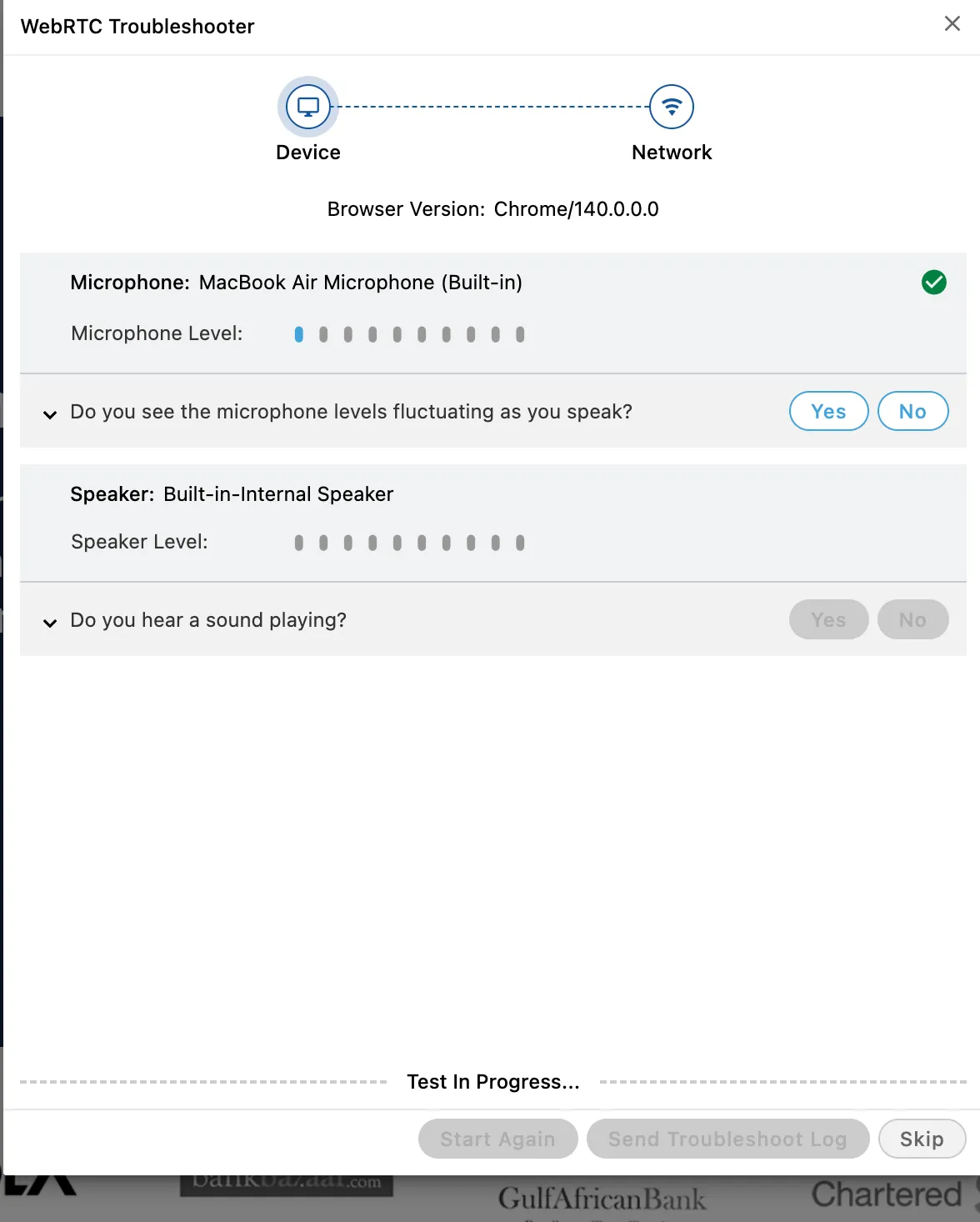
- WebRTC Troubleshooter: To access the full diagnostic tool, the agent clicks the Troubleshooter Icon within the pop-up. This opens the dedicated WebRTC Troubleshooter interface for deeper analysis.
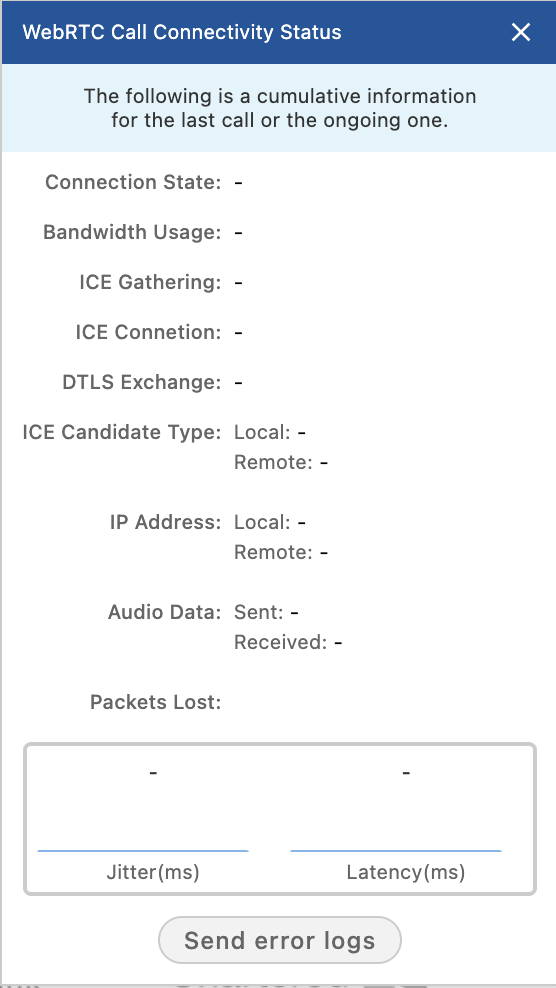
- Connectivity Stats: To view real-time network metrics, the agent clicks the Network Icon within the pop-up. This displays the detailed Connectivity Stats.
Core Functionality
- WebRTC Status Indicator (Initial Check): This primary indicator (visible after clicking the Phone Icon) confirms the registration state of the softphone.
- Green Status: Indicates WebRTC is properly registered and ready for calls.
- Red Status: Indicates WebRTC is not registered, and the agent cannot make or receive calls.
- Troubleshooter Interface: (Accessed via Troubleshooter Icon) Allows the agent to run diagnostics or view specific parameters that may be impacting call quality or connection reliability.
- Connectivity Stats: (Accessed via Network Icon) Provides real-time statistics on network performance relevant to VoIP, such as latency or packet loss, which are crucial for assessing call quality.
Use Cases
- Call Quality Degradation: If an agent experiences dropped calls or choppy audio, they can access the Connectivity Stats to check for high latency or jitter.
- No Incoming Calls: If the agent is in the "Available" state but receives no calls, checking the initial WebRTC Status indicator (Red) and then the Troubleshooter can help pinpoint a registration failure.
- Network Change Verification: After making a network or headphone change, the agent can use the tool to verify that the WebRTC connection is stable before taking calls.
Benefits
- Fast Issue Isolation: Allows agents to quickly determine if a call issue is related to their WebRTC connection or local network rather than a campaign or system-wide problem.
- Reduced IT Load: Offloads initial voice troubleshooting from the Administrator/Voice-Admin to the agent, enabling quicker resolution.
- Proactive Monitoring: Encourages agents to monitor their own connection health throughout the day.
Configuration Flags
Flag | Default | Description |
|---|---|---|
disableTroubleshooterButton | false | When set to true, hides the Troubleshooter icon from the Agent Console phone menu. Use this in deployments where troubleshooting is handled centrally by IT. (Available from 4.13.5.HF01) |
disableWebrtcNoiseSuppression | false | When set to true, disables the automatic noise-suppression filter applied to WebRTC audio streams. Useful for environments where external noise-cancellation hardware is already in place. (Available from 4.13.45) |
WebRTC Infrastructure Options
Geolocation Failover via Kamailio (4.13.8+)
For deployments spanning multiple geographies, WebRTC registrations can be routed through a Kamailio SIP proxy that performs geolocation-based failover. If the primary call server in a region is unavailable, the proxy automatically redirects the WebRTC session to the nearest healthy server, minimizing call setup latency and improving resilience.
Central Registrar for Multi-Call-Server Failover (4.13.25+)
A Central Registrar option allows WebRTC endpoints to register against a centralized service instead of individual call servers. When a call server goes down, the Central Registrar re-routes active and new registrations to surviving servers transparently, without requiring agents to re-login or manually switch endpoints.
Limitations
- Agent Action Required: The agent must be aware of the tool and its indicators to effectively use it for troubleshooting.
- Administrator Dependency: While the tool helps identify the source of the issue, resolution often requires an Administrator or IT personnel to check system configurations (e.g., firewall settings, Call Manager status).
Version History
Version | Enhancement | Release Notes |
|---|---|---|
4.13.5.HF01 | disableTroubleshooterButton flag to hide troubleshooter control | |
4.13.8 | WebRTC geolocation failover via Kamailio | |
4.13.25 | Central Registrar option for multi-call-server failover | |
4.13.45 | Auto noise suppression via disableWebrtcNoiseSuppression flag | Contact Center - Patch Release Notes - Version 4.13.454.13.45 Release Notes |