Outbound Voice Introduction
Overview
Outbound voice is a capability that allows your contact center to initiate calls to customers rather than waiting for them to reach out. Instead of a customer dialing in, your system — or your agent — places the call outward to a phone number.
This is commonly used for:
- Sales and lead follow-ups — reaching out to prospects or leads from a CRM list
- Appointment reminders — automated calls to remind customers of upcoming bookings
- Payment and collection calls — proactively notifying customers about dues or overdue accounts
- Customer verification — calling back to confirm identity or complete a transaction
- Surveys and feedback — post-interaction calls to collect customer experience data
- Alerts and notifications — time-sensitive updates like delivery status or service disruptions
Outbound Call Types & Initiation
Outbound calls can be initiated in several ways in Exotel Enterprise Contact Center Solution:
- Auto Dial: Automated predictive or progressive dialing as part of an outbound campaign where the agent receives a live call.
- Manual Dial: An agent manually enters and dials a customer's number from the user interface.
- Preview Dial: Customer details are displayed to the agent before the system dials, allowing the agent to accept or reject the dial attempt.
- Callback Dial: The agent receives a call for a previously scheduled callback.
- Click-to-Dial: A number is dialed directly by clicking it from a CRM web page or customer information field.
Outbound Dialing Algorithms
The system uses specific algorithms to determine how and when to dial depending on the business use case. Detailed explanation of outbound dialing algorithms are provided in the Dialing Modes and Settings - IntroductionDialing Modes section.
Routing in a Voice Campaign (from Administrator interface)
Here, you can create and manage the routing for both Inbound and Outbound Calls in Interactive Voice Application Campaign, Outbound Campaign, and Parallel Predictive Campaign.
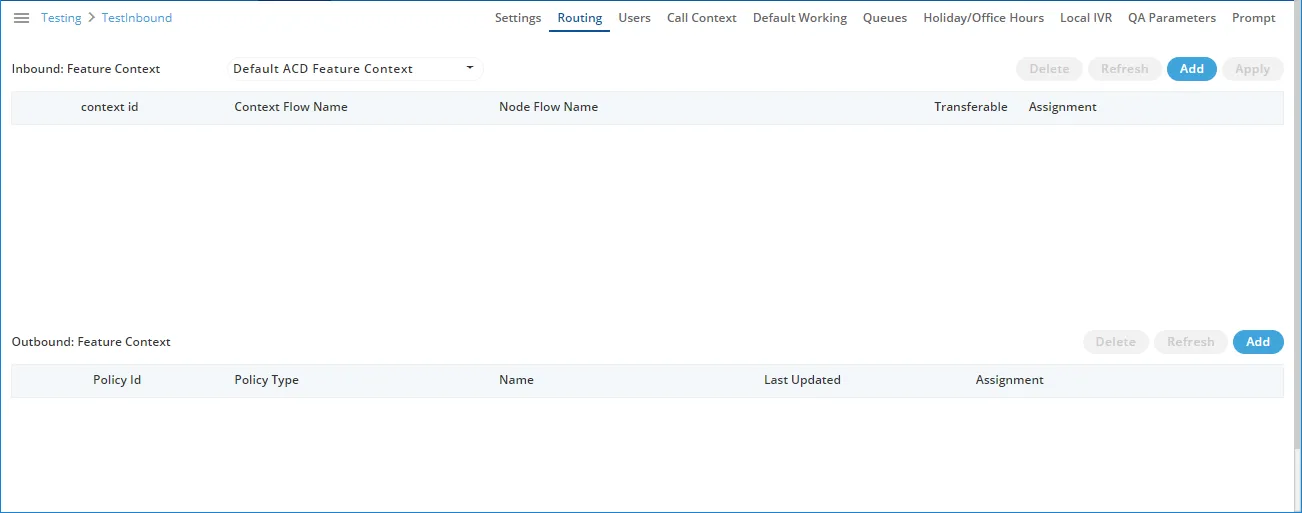
Routing for Outbound
In "Outbound: Feature Context" section, perform the following steps.
- Click "Add" to add a routing policy for the Outbound feature context.
- It creates a new row in the blank area.

- Select any of the following Policy Types: (for detailed information on outbound call context policies, check out the Outbound Call Context Policieslink)
- Basic Single Call Context Type: It is the policy type in which outbound calls will be dialed out from the single call context.
- Phone Based Call Context Type: It is the policy type in which administrator can define the pattern on basis of which numbers will be dialed out from multiple call context. It will only reflect after procuring appropriate licenses.
- Basic Multiple Call Context Type (Licensable): It is the policy type in which outbound calls will be dialed out from multiple call context. It will only reflect after procuring appropriate licenses.
- Multiple Type Round Robin Call Context Type: It is the policy in which if a call tried by a call context fails to get connected, then it will be tried by the different call contexts that are selected for calling as per Round-Robin algorithm. As per Round-Robin Algorithm, each call context is used to call for a fixed amount of time and if the call does not get connected in that duration, another call context is used. The left over call context is reused when all other call contexts in the loop are used and the call is still not connected.
Make sure to not provide a name for the Routing for any "Outbound: Feature Context". The name will be assigned automatically after selecting the call contexts.
The Outbound Routing with manual names will not work.
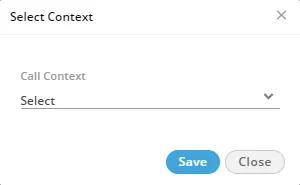
- Click "Assign" link under "Assignment" header to select a call context that you have assigned in this campaign in "Call Context" Tab. Following pop-up is displayed for "Basic Single Call Context Type" on the page.
For "Phone Based Call Type", "Basic Multiple Call Context Type", and "Multiple Type Round Robin Call Context Type", the following pop-up appears to select the multiple call contexts.
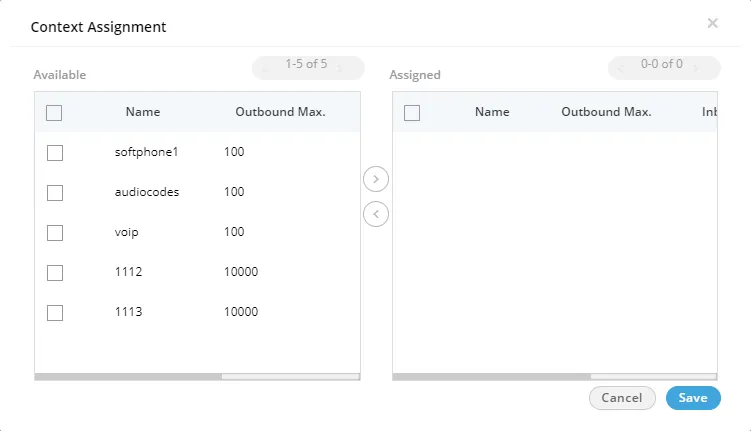
Perform the following steps to assign call contexts to this new policy.
- Select the call contexts in "Available" section
- Click
 icon to proceed to assign the selected call contexts
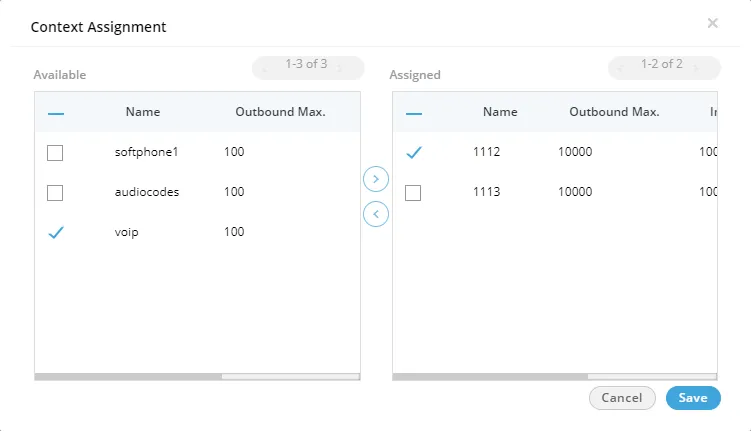
- Click "Save" to assign the call contexts to this campaign. Rather, you can click "Cancel" to not assign the Call Contexts.
To unassign a call context, click the link under "Assign" header for a new or existing Outbound Routing Policy, select a call context in "Assigned Call Contexts" section, click  icon, and click "Save" to unassign the selected call context from the campaign.
- Click "Save" to proceed to add the selected context to the routing policy.
- Click "Apply" to create the Routing Plan for Outbound.
You can create multiple routing policies for the Outbound Feature in the Interactive Voice Application (Inbound) Campaign.

You can only change the selected Call Contexts while modifying an Outbound Routing Policy. In addition to that, you can also delete a routing policy.
Delete Routing Policy
Select the Routing Policy for which you want to delete permanently. Click "Delete" button. A confirmation pop-up comes up.

Click "Yes" if you want to delete the routing policy, else click "No".
Saving Routing Test Result
When an administrator creates a routing test case, they may want to check that test case frequently so that any issues in the routing can be figured out easily. Allowing the administrator to save these test results saves an enormous amount of time for them.
On the Routing Test screen, the administrator can save the test cases. The saved test cases are listed on the same screen.
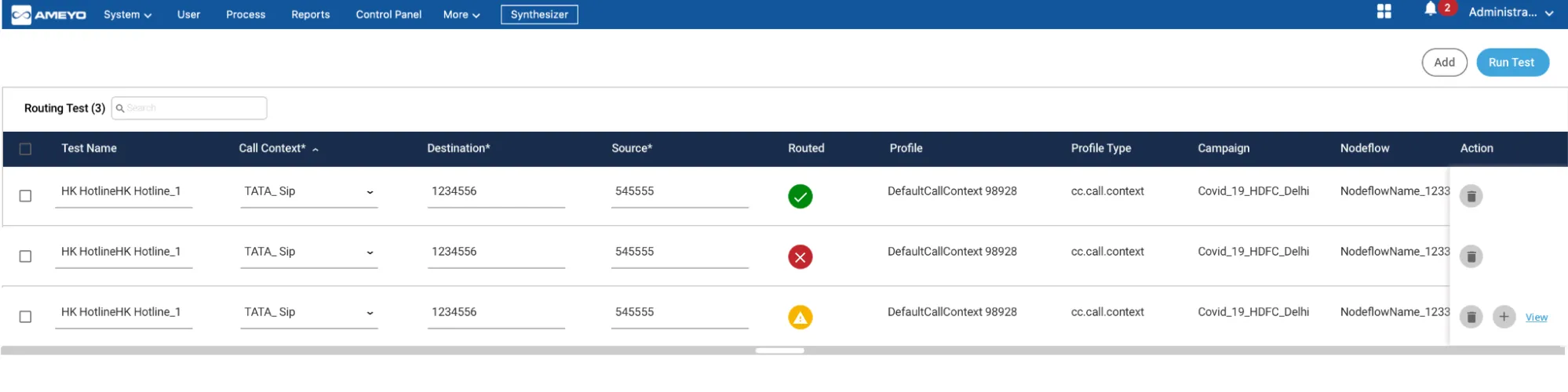
- Administrator can also perform the following actions
- Delete a test case or select multiple test cases and delete them
- Search for a test case
- Select the test case(s) they want to run
- Edit a test case.